

J.T. McDaniel Official Site
Audio Books
 Interview with J.T. McDaniel
2001
It turned out to be quite easy to get an interview with author J.T. McDaniel, whose novel, With Honour in Battle, was just published by Writer’s Club Press. (This interview was conducted in 2001. The novel was republished by Riverdale Books in 2003.) We met with him in the Spartanly furnished living room of his apartment in a southern Atlanta suburb, where we found it very easy to feel at ease. While speaking to us, McDaniel relaxed in a big recliner, occasionally sipping from a bottle of water. Plain tap water, it turned out, despite the label on the bottle. (Of course, 99% of bottled water sold in American supermarkets is simply filtered tap water to begin with.)
Interviewer: So it’s not really bottled water?
JTM: It’s in a bottle, so technically I suppose it is, but, no. I buy a couple bottles once in a while, but mostly I just refill them in the kitchen. The only reason I ever buy bottled water is if I need a new bottle.
Interviewer: Well, we’re not here to talk about water, obviously.
JTM: Not if we can talk about my book, no. Kroger isn’t going to pay me for plugging their product anyway. Not if I’m just refilling the bottles.
Interviewer: Particularly not in that case.
JTM: Particularly not then. So shall we talk about the book instead?
Interviewer: Good idea. What inspired you to write With Honour in Battle? You never served on a submarine, did you?
JTM: I’ve been aboard exactly three submarines in my entire life, all on tours. The Gar in Cleveland, back when I was in grade school, and the Cod, also in Cleveland, much more recently. Both of those were old fleet boats. The Gar was used as a Navy Reserve training vessel, but they’d removed the screws, so she couldn’t actually leave the pier. The story was that no armed vessels were allowed on the Great Lakes because of a treaty with Canada, and you got around it by removing the screws. That’s not really true, though. The real reason for removing the screws was that they’re made of bronze, and removing them avoids electrolytic corrosion of the steel hull. Also, if you remove the screws, you can weld a cap over the end of the tailshaft housing and eliminate another potential leak. And if you’re never planning to take the boat away from the pier, you don’t need the screws anyway.
The Cod replaced the Gar in 1959, but was also retired a few years later, as by then the Navy’s submarine force had gone almost completely nuclear, and there wasn’t much need for diesel training boats. Cod is a museum now, tied up along North Marginal Road, between Burke Lakefront Airport and the Naval Reserve Center. I understand that she has the distinction of being the only boat of her type (Gato class) that could still conceivably dive, as all the others have had access stairs added that would make it impossible to seal the pressure hull.
I also visited U-
Interviewer: But you were in the Army yourself, not the Navy?
JTM: Right. I enlisted in ’67, went through the Defense Information School at Fort Benjamin Harrison outside Indianapolis, then did a tour in Viet Nam.
Interviewer: Defense Information School doesn’t exactly sound like combat training.
JTM: It wasn’t. DINFOS is a Defense Department school, which means you get students and instructors from all the services. If I remember right, my roommates were another soldier, a Navy petty officer, and a Marine. DOD took ten weeks to drill what amounted to nearly the full course load for a BA in journalism into you. You didn’t get a degree, though; just a diploma. After that I was off to Viet Nam.
Interviewer: So, if you weren’t in combat, what did you do there?
JTM: I didn’t say I was never in combat—it just wasn’t my primary job. Mainly, I was the guy who wrote the press releases after action. I also edited a unit newspaper, which was how I learned that some officers were never issued a sense of humor. I spent a certain amount of time getting shot at, too. It was supposed to make the stories more accurate, or compelling, or first-
Interviewer: Where did you serve?
JTM: Mainly at Camp Eagle, which was up at Phu Bai, a few miles from Hue. I was originally assigned to the 308th Combat Aviation Battalion, which was attached to the 101st Airborne Division. A few months later the 308th was taken into the 101st when the division went airmobile. The 308th became the 159th Assault Support Helicopter Battalion. We kept the Chinooks and other heavy lift helicopters, and the Hueys went to the 101st Aviation Battalion. I finished out my tour at Division Rear at Bien Hoa Army Base, just outside Saigon. Der Schwartze Adler, the restaurant U-
Interviewer: Okay, you’ve manage to work your way back to your book. What’s the main premise?
JTM: It’s a war story, obviously. We take an officer who’s just returned from a particularly dangerous patrol, and immediately throw him into command of a brand-
Interviewer: But why did you chose to make it a German submarine and not, say, an American one?
JTM: A lot of it was the technology. At the end of the war, the Germans had some submarines ready to deploy that were years ahead of anything we had. It was hard to resist the temptation to use one of these, especially when you couple that with the fact that, by late 1944, it had to be obvious to everyone in the Kriegsmarine that Germany was going to lose, and probably very soon. There was also the fact that, with a 75% loss rate for U-
Interviewer: Light? Twenty-
Interviewer: But the sub in your book is real?
JTM: Theoretically, I suppose. U-
Interviewer: Why pick that one, then, as opposed to one that was actually built?
JTM: It gives you greater flexibility, for one thing. If you say that the boat could dive to such and such a depth, and there was a real boat that had been tested, you’d better be sure you got the depth right. If the boat existed only on the drawing board, though, you can just use what the designers were hoping the figures would be. For instance, Typ XXI boats were supposed to be able to dive to 1,000 feet, but it turned out that hatch seals started leaking well shy of that, so the design depth wasn’t practical. They could still dive deeper that any Allied submarine, though, and if they could have fixed the hatch seals the 1,000 depth would have been practical. German subs in general were deeper diving than Allied boats.
I’ll also admit to taking a few liberties here and there. For dramatic purposes, U-
As it turns out, the attack center was in the control room, and the tower was much lower than usual, with only an escape trunk between the control room and the bridge. I don’t think these technical details affect the story, mind you. The boat is the setting for the story, not a central character, as in a lot of techno-
Interviewer: What about the ships mentioned in the book? Are any of those real?
JTM: There were genuine counterparts to several, of course. The real U-
Interviewer: No real people in the book, then?
JTM: Some, sure. Hitler was real. So were some of the off-
Interviewer: Do you have a favorite character in the book?
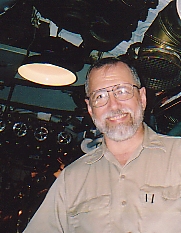
JTM: Kruger, the captain, looks a lot like me, so probably him.
Interviewer: Any reason for that? Looking like you, I mean?
JTM: When I wrote the book, I was planning to try to convince any potential fill producers that they should cast me in the part when they made the movie. Mind you, this was originally written about 20 years ago, when it wouldn’t have been much of a stretch for me to play a 27-
Interviewer: Other than yourself, do you have any thoughts on who should play any of the characters if they make a movie?
JTM: I do, though some of them may tend to be a bit unconventional. For unfathomable reason I keep picturing Alan Ruck as Kruger now. Minus the glasses, and with a different haircut, of course. I’m not even sure why, since the closest thing to a serious role I’ve ever seen him in was that ten minute stint as the captain of the U.S.S. Enterprise in Star Trek: Generations, and his character came across as somewhat less than 100% efficient in that job. I suppose he just has the right “look” for the part, and I’ve never seen a good comic actor who couldn’t do drama very effectively.
Interviewer: Anyone else?
JTM: If he was younger, and dropped the American accent, I think John Mahoney would be a good Ralston. Unfortunately, the book makes it very clear that Ralston would be about 33. Craig Ferguson might be able to pull it off. I sort of picture Ralston as the sort who would tend to come off a vaguely upper class English, but revert to something a bit less refined when he gets upset. But, as I said, my casting ideas are probably not in line with what an actual producer would suggest. They’d no doubt go for box office record as the primary criteria.
Interviewer: Any other favorites in the book?
JTM: Strangely enough, Ostler. He’s a complete jerk, not to mention being the only dedicated Nazi aboard the boat. He’s a fairly minor character, mind you. Also one with some pretty deeply held secrets, which I’m not going to reveal here. He turns out to be pretty interesting before he’s done, though.
Interviewer: Do you have any problems with making Nazis the heroes in this book?
JTM: I’d have a major problem if I’d done that. But I didn’t. Except for Ostler, the rest are simply professional naval officers and ratings. The German Navy was probably the least political of all the services. Most World War II German military equipment had swastikas painted all over it, but Naval vessels generally displayed that only on the ensign, where it had replaced the Imperial eagle, and painted on the deck of major surface ships as an air recognition symbol, so that German bomber pilots wouldn’t attack their own ships.
When he was commander in chief, Raeder did everything he could to protect Jewish naval personnel from the party, though there’s really nothing to indicate that he actually liked Jews. There is a story, possibly apocryphal, possibly not, that there were still Jewish officers aboard Bismarck when she attempted her breakout into the Atlantic. Officially, all Jewish personnel had been purged by then. Unofficially, there are stories that the Navy may have aryanized a lot of records, or just ignored the orders in order to retain the men. Dönitz was closer to Hitler than Raeder, but there has always been a dispute as to whether he was a Nazi himself, or if he simply figured out that he’d be more successful at keeping the party from meddling in Navy business by staying close to Hitler. He was certainly more honest when it came to saying what was going on with the war than most senior officers, who usually just told Hitler whatever they thought he wanted to hear.
Interviewer: Do you have any favorite authors? Anyone who’s influence you to write?
JTM: I’ve had several favorites over the years. I read a lot of Ian Fleming when I was in high school. And I was practically addicted to Richard S. Prather’s Shell Scott series. Someone once described Scott as being “politically slightly to the right of Hitler,” but I never noticed that. I always thought he was pretty conservative on the old “Red Menace” issues, but actually damned liberal when it came to civil rights. He probably would have been a Republican, but that was back in the days before the party was hijacked by the special interests.
I also went through a period when I read a lot of fantasy. Robert E. Howard and the like. For naval adventure writing, I’m still very fond of Douglas Reeman, along with Alexander Kent, who is, of course, merely Reeman using a pen name for his Richard Bolitho series. I even carried on a fairly lengthy correspondence with him back in the late 1970s and early 1980s. And we certainly can’t forget C.S. Forrester and his Hornblower novels. Today, of course, there’s Tom Clancy. I don’t write the sort of techno-
Of course, like just about anyone interested in submarines, I’ve also read both the fiction and non-
Interviewer: Where did the information for the technical stuff come from?
JTM: A read a lot. And if it was important to the plot, and theoretically possible, sometimes I just made it up. But most of what happens was possible with the submarine technology of the mid-
Interviewer: If you’ve corresponded with some authors, does that mean you’ll write back to people?
JTM: I make no guarantees, but if someone wants to email me here, they might get an answer. They might not, too. Like I said, no guarantees.
 Interviewer: What are you working on these days?
JTM: The main project is Bacalao. Another submarine story, but this time aboard an American fleet boat in the Pacific theater. I’m in the middle of the third draft now. Probably with some final polishing, that will be the one that ends up on the shelves.
Interviewer: Any particular problems?
JTM: Just the usual sort of thing. I thought it was about the boat’s captain, but somewhere in the middle of the first draft one of the minor characters, a lieutenant named Miller, grabbed me by the shirt and pointed out that the book was really about him. Two drafts later, I have to agree with him. It’s a much more interesting story from his viewpoint.
Interviewer: So Miller is your favorite character?
JTM: Well, he’s generally the viewpoint character, in any case. There are others who certainly qualify as equally, or possibly even more interesting. Andy Morley, Bacalao’s original captain, for instance. Then there’s Electrician’s Mate 1st Class Kenneth Ohara, who is very good at his job and manages to win a Navy Distinguished Service Medal (at that time ranking just below the Medal of Honor, though later dropped back to number three in precedence and the Navy Cross moved up to number two) on their first war patrol when all hell breaks loose in the maneuvering room, but for an American submariner suffers from the distinct problem of having picked the wrong ancestors and consequently looking way too much like the guy’s they’re fighting.
Interviewer: Did you manage to catch all the goofs in this one?
JTM: I hope so. There is, admittedly, one obvious anachronism, but that one was intentional, so call it dramatic license. I’ve got Bacalao at Pearl Harbor during the attack, and the first Gato class sub didn’t actually get there until a couple months later. But since this is an American sub, and there are several examples still around, it’s a lot easier to check things than it would be if I made her a Tambor class boat. I have some friends who served in these boats, too, and I’m running it all past them. They’ve caught some things here and there.
Interviewer: Such as?
JTM: Technical things, mostly. Details on the deck guns, for instance.
Interviewer: Anything else in the works?
JTM: There’s also a short story collection, tentatively titled Eighteen Hours, which includes some sub stories, but also wanders off into other areas. (Note: Eventually, with some additions, this became Blackout & Other Stories.)
Interviewer: Well, I want to thank you for the interview. I hope your books become huge hits.
JTM: I certainly hope. You do have a pretty strong interest in that, after all.
Interviewer: Does that mean you’re admitting that I’m you, and you’ve been interviewing yourself?
JTM: I wasn’t going to, but since you just did…
| Coming Out Website |
| 2001 Interview |
| 2005 Interview |
| May 2006 Interview |
| January 2014 Interview |
| Run Silent, Run Deep |
| Submarines at War |
| Harry Potter and the Cursed Child |
| Wahoo |
| The PaxAm Solution |
| Sea of Shadows |
| The Manor |
| Broadway Nights |
| Shrek, the Musical |
| The Phantom of the Opera |
| Love Never Dies |
| Returning - Sample No. 1 |
| Returning - Sample 2 |
| Returning - Sample 3 |
| Returning - Sample 4 |
| Returning - Sample 5 |
| Returning - Sample 6 |
| Characters & So Forth |
| Romiwero Interview |
| How a Submarine Dives |
| How a Persicope Works |
| Asdic, Sonar and Detection Gear |
| The Walter Turbine |
| The Typ XXVI Walter U-boat |
| The Revell 1:72 Scale Gato |